
Google Ads Getting Clicks But No Leads? 7 Reasons Your Budget Is Being Wasted
If your Google Ads are getting clicks but not calls, form submissions, bookings, or sales, the problem is usually not that Google Ads “doesn’t work.” The problem is usually the campaign setup, landing page, targeting, or tracking. Here are the most common reasons your ad budget may be getting wasted.
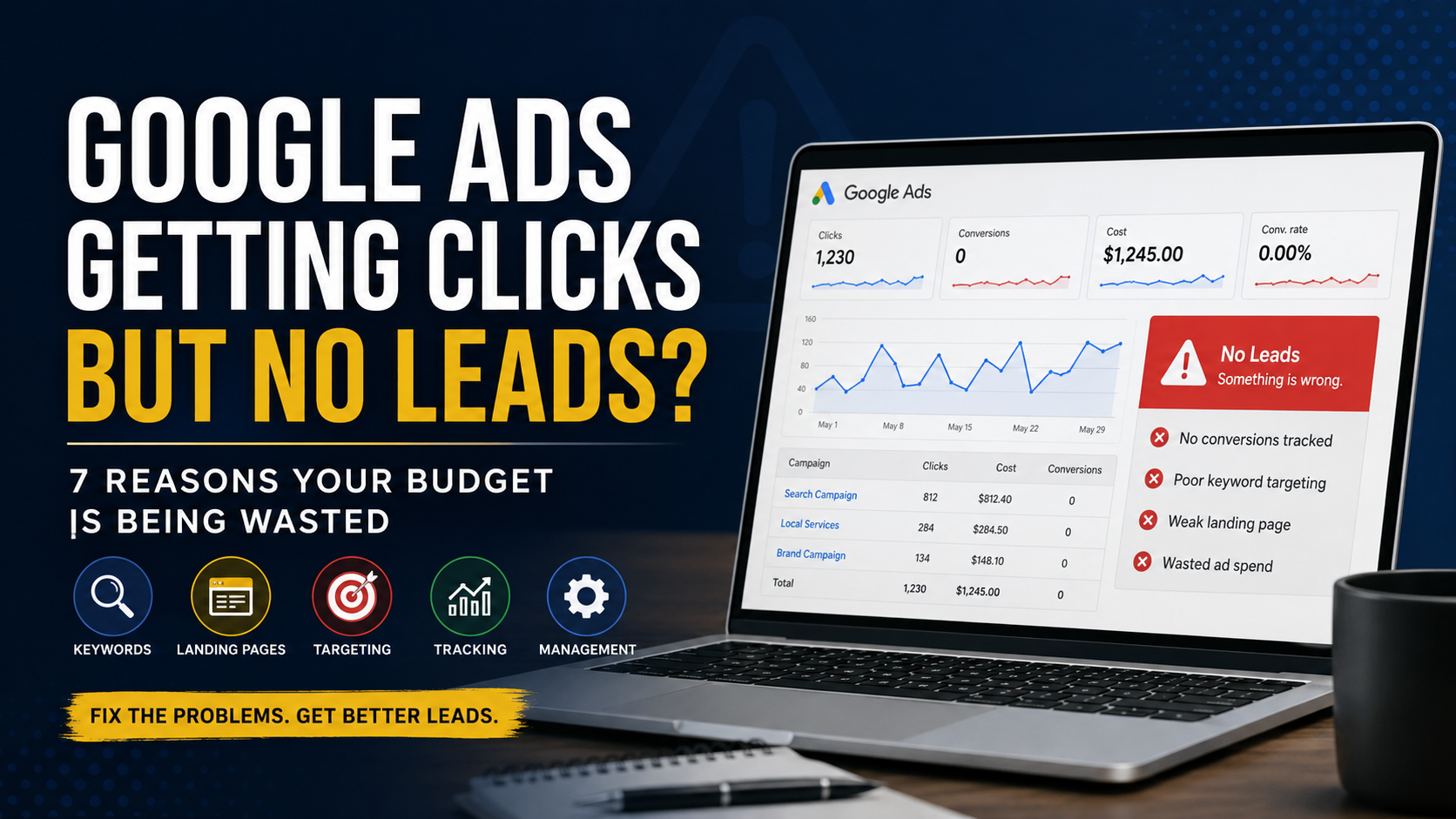
Google Ads can be one of the fastest ways to get in front of people who are already searching for what your business offers. That is the good news.
The bad news is that Google Ads can also burn through money fast when the campaign is not set up correctly.
A lot of business owners have the same frustrating experience. They launch ads, start getting clicks, see the budget disappear, and then wait for the phone to ring. Sometimes a few people visit the website. Maybe a form gets filled out here and there. Maybe the campaign dashboard looks active. But at the end of the month, the business owner is left asking the same question:
Why am I paying for clicks if those clicks are not turning into leads?
That question matters because clicks do not pay the bills. Leads do. Calls do. Bookings do. Estimate requests do. New customers do.
If your Google Ads are getting clicks but no leads, it does not always mean Google Ads is the wrong platform for your business. In many cases, it means the campaign is attracting the wrong people, sending them to the wrong page, tracking the wrong actions, or failing to give prospects a strong enough reason to contact you.
This is especially common for local service businesses. A roofing company, med spa, cleaning company, auto shop, dental office, massage therapist, landscaper, HVAC company, or home service provider can spend hundreds or thousands of dollars on traffic without realizing the campaign is leaking money in multiple places.
The problem is not usually one single thing. It is usually a combination of small issues that add up. The keywords are too broad. The location targeting is too loose. The ad copy is generic. The landing page is weak. The call button is hard to find. The form is too long. The tracking is broken. Nobody is checking the search terms. The campaign is technically “running,” but it is not being managed like a lead generation system.
That is the difference between running ads and running ads profitably.
Below are seven reasons your Google Ads may be getting clicks but not generating leads.
Reason 1: You Are Paying for the Wrong Keywords
The first place to look is the keyword strategy.
A keyword is not just a phrase. It is a signal of intent. Some people search because they are ready to buy. Some search because they are researching. Some search because they are comparing prices. Some search because they want a job. Some search because they want free information. If your ads are showing for searches with weak intent, you can get plenty of clicks without getting many real leads.
For example, there is a big difference between someone searching “how to clean a roof yourself” and someone searching “roof cleaning company near me.” The first person may be looking for a DIY tutorial. The second person is much closer to hiring someone.
The same idea applies to almost every service business.
A person searching “what is paint protection film” may just be learning. A person searching “paint protection film installer near me” is more likely to become a lead.
A person searching “massage benefits” may be doing general research. A person searching “deep tissue massage near me” is much more likely to book.
A person searching “how much does Google Ads cost” may be researching. A person searching “Google Ads management company for local business” is closer to needing help.
When a campaign is built around broad or vague keywords, it may create activity without creating revenue. The dashboard can show impressions, clicks, and traffic, but those numbers do not mean much if the people clicking are not qualified buyers.
This is where many campaigns go wrong. They focus on traffic instead of intent.
A good Google Ads campaign should separate high-intent searches from low-intent searches. It should prioritize the terms that show someone is ready to act. For local businesses, that usually means keywords tied to services, locations, urgency, pricing, estimates, appointments, and “near me” intent.
The goal is not to get the most clicks. The goal is to get the right clicks.
If your campaign is getting clicks but not leads, review the actual search terms people typed before clicking your ads. Not just the keywords you added to the campaign. The real search terms. That report often reveals wasted spend quickly. You may find that your budget is going toward people looking for jobs, free advice, unrelated services, competitor names, or searches that are too broad to convert.
Once you see that, the fix becomes clearer. Tighten the keywords. Add negative keywords. Separate buyer-intent keywords into their own ad groups. Stop treating every search as equal.
Reason 2: Your Match Types Are Too Loose
Keyword match types control how closely someone’s search needs to match your keyword before your ad can show. This matters because a keyword that looks good on the surface can behave very differently depending on the match type.
Broad match can help reach more searches, but it can also pull in traffic that is not as specific as you expected. Phrase match gives more control, but it can still match to related searches. Exact match is more restrictive, but even exact match can include close variants.
None of these match types are automatically bad. The problem happens when they are used without a strategy.
If a business owner sets up a campaign quickly, accepts default recommendations, and uses broad match keywords without enough negative keywords or conversion data, the campaign can start spending on searches that are not a great fit. Google may find clicks, but clicks are not the same as qualified leads.
This is especially risky when the campaign has a small budget. A business spending $500, $1,000, or $2,000 per month does not have unlimited room for wasted traffic. A few bad clicks every day can eat up the budget before the best prospects ever see the ad.
Loose match types can also make performance harder to understand. You may think you are advertising for one service, but the actual searches could be drifting into other topics. That means the ad copy may not match the search well. The landing page may not match the user’s need. The visitor may click, look around for a few seconds, and leave.
Then the campaign gets blamed.
The better approach is to use match types intentionally. Start with the services that matter most. Build tightly themed ad groups. Review search terms often. Add negative keywords aggressively. Use broad match carefully, especially when the account does not have reliable conversion tracking or enough historical conversion data.
Google Ads can work well, but it needs boundaries. Without those boundaries, the platform may spend your money learning lessons that could have been avoided.
Reason 3: Your Ads Are Too Generic
A person searching on Google is usually moving fast. They type a search, scan the results, and make a quick decision. If your ad sounds like every other ad on the page, you are giving them no strong reason to choose you.
Generic ad copy is one of the easiest ways to waste good traffic.
Many ads say things like “professional service,” “trusted experts,” “high quality work,” or “contact us today.” Those phrases are not necessarily wrong, but they are weak by themselves. Every business says some version of them.
Your ad needs to answer the silent question in the customer’s mind:
Why should I click this one?
For a local service business, strong ad copy should connect directly to the search intent. If someone searches for emergency plumbing, the ad should speak to speed, availability, and solving the urgent problem. If someone searches for cosmetic dentistry, the ad should speak to confidence, appearance, consultations, and results. If someone searches for Google Ads management, the ad should speak to wasted ad spend, better tracking, better leads, and clearer reporting.
The more specific the search, the more specific the ad should feel.
Good ad copy also pre-qualifies the visitor. You do not want every possible click. You want the right click. If your service starts at a certain price point, your ad and landing page should not attract people looking for the cheapest possible option. If you serve a specific area, the ad should make that clear. If you specialize in a certain type of customer, say it.
Clarity beats cleverness.
Another common issue is that the ad promises one thing and the landing page delivers something else. For example, the ad says “Free Google Ads Audit,” but the landing page sends visitors to a general homepage with no mention of an audit. That mismatch creates friction. The person clicked for a reason, and the page failed to continue the conversation.
Your ad should not be treated as a separate piece of marketing. It is the first step in a path. The keyword, ad, landing page, offer, and call to action should all feel connected.
If they do not, the visitor feels it immediately.
Reason 4: Your Landing Page Is Not Built to Convert
A lot of Google Ads campaigns fail after the click.
The user searches. The ad gets their attention. They click. Then they land on a page that is slow, cluttered, vague, confusing, or not built for action.
This is where many businesses waste money.
Your homepage is not always the best landing page for paid ads. A homepage usually has too many paths. It talks about the whole business, all the services, the company story, maybe the team, maybe a gallery, maybe a blog, maybe several buttons. That can be fine for general website visitors, but paid traffic needs a clearer path.
A strong landing page should continue the exact conversation started by the search and the ad.
If the ad is about Google Ads management, the page should be about Google Ads management. Not general marketing. Not every service the agency offers. Not a vague overview. It should explain the problem, show why it matters, present the solution, build trust, and make the next step obvious.
For local service businesses, the page needs to answer the questions prospects care about quickly. What do you do? Where do you serve? Why should I trust you? What happens next? How do I contact you? Is this the right fit for me?
The call to action should be visible without making the visitor hunt for it. Phone number. Form. Booking button. Estimate request. Whatever matters most should be obvious.
The page also needs to work well on mobile. Many local searches happen from phones. If the page loads slowly, the phone number is hard to tap, the form is annoying, or the layout feels messy, people will leave. You still pay for the click.
A good landing page does not need to be complicated. It needs to be clear.
The headline should match the offer. The first section should tell the visitor they are in the right place. The proof should be easy to see. The form should be short enough to complete. The page should reduce doubt and make action feel simple.
If you are spending money on Google Ads but sending people to a weak page, increasing the budget will usually make the problem more expensive. Fix the page before scaling the campaign.
Reason 5: Your Conversion Tracking Is Broken or Misleading
You cannot improve what you cannot measure.
Conversion tracking is one of the most important parts of a Google Ads campaign, yet it is often missing, incomplete, or set up incorrectly. A campaign may be counting page views as leads. It may be counting every button click even when no form was submitted. It may not be tracking phone calls. It may be missing calls from mobile users. It may be tracking old thank-you pages that are no longer used.
When tracking is wrong, the campaign starts optimizing around bad information.
That creates two major problems.
First, you may think the campaign is performing better than it actually is. If Google Ads is counting weak actions as conversions, the dashboard may look healthy while the business is not actually getting quality leads.
Second, Google’s bidding system may learn from the wrong signals. If the platform is told that low-value actions are conversions, it may try to find more people likely to complete those low-value actions. That can lead to more junk leads, more irrelevant form fills, or more traffic that looks good in the account but does not help the business.
For lead generation, the most important conversions are usually phone calls, form submissions, bookings, quote requests, purchases, and other actions that show real buying intent. Secondary actions can still be useful, but they should not be treated the same as a qualified lead.
Call tracking is especially important for local businesses. Many customers do not fill out a form. They call. If calls are not being tracked properly, you may be missing a large part of the campaign’s real performance.
The opposite can also happen. Sometimes ads are producing calls, but the business is not answering them, not calling back quickly, or not asking how the lead found them. In that case, the campaign may be creating opportunities that are being lost after the click.
Tracking should connect marketing activity to real business outcomes as much as possible. Not just impressions. Not just clicks. Not just website visits. Leads, calls, bookings, and revenue.
Without that, decisions become guesses.
Reason 6: Your Location Targeting Is Too Broad
Location targeting sounds simple, but it can waste a lot of money when it is not set up carefully.
A local business does not need clicks from people outside its service area. It also may not need clicks from every city in a large metro area. The right location strategy depends on where the business can actually serve, where the best customers are, and where the budget can compete.
If your campaign targets too wide of an area, your budget may get spread too thin. Instead of showing consistently in the best locations, your ads may show occasionally across too many places. That makes it harder to generate enough qualified traffic in the areas that matter most.
For example, a business that really wants customers in Nashville may not benefit from spending equally across every nearby city. A contractor may want leads within a certain drive time. A med spa may know that certain suburbs produce better customers. A cleaning company may only serve commercial clients in specific parts of town.
The campaign should reflect that.
Another issue is location intent. Some people search for services in a city even if they are not physically located there. Others are physically nearby but searching for a different location. Google Ads has settings that can affect whether ads show to people in the targeted area, people interested in the area, or both.
For local lead generation, this needs to be reviewed carefully. Otherwise, a campaign can pay for clicks from people who are not actually good prospects.
Location targeting should also be matched with the landing page. If your ads target Nashville, the page should make Nashville service clear. If your ads target multiple cities, consider whether each city needs a more relevant page or message. People want to know they are dealing with a business that serves their area.
Local relevance improves trust.
If your campaign is getting clicks but no leads, check where the clicks are coming from. You may find that the budget is being spent in areas that rarely convert.
Reason 7: Nobody Is Managing the Campaign After It Launches
Google Ads is not something you set once and ignore.
A campaign can be launched correctly and still drift over time. Search behavior changes. Competitors change their ads. Costs move. New search terms appear. Some keywords get expensive. Some ads stop performing. Some locations outperform others. Some devices convert better than others. Tracking issues appear. Landing pages break. Offers get stale.
If nobody is checking the account regularly, wasted spend becomes normal.
This is one of the biggest differences between a campaign that is simply active and a campaign that is actively managed.
A managed campaign is reviewed and adjusted. Search terms are checked. Negative keywords are added. Poor-performing keywords are paused. Budgets are shifted toward stronger areas. Ad copy is tested. Landing page issues are identified. Conversion quality is reviewed. Calls and forms are compared against actual business results.
This matters because Google Ads is not just about launching. It is about improving.
Many business owners think the hard part is getting the campaign live. In reality, the real work begins after launch. The first few weeks often reveal what the market is actually doing. Which searches are worth paying for? Which ones are junk? Which ads get attention? Which pages convert? Which cities perform best? Which leads are actually valuable?
That information should shape the campaign moving forward.
If your Google Ads have been running for months and nobody has made meaningful changes, that is a red flag. If search terms have not been reviewed, conversion tracking has not been checked, and landing pages have not been tested, the campaign may be wasting money quietly.
The account may look active, but activity is not strategy.
Before You Spend More, Check These First
Before increasing your Google Ads budget, check the foundation. More budget does not fix a broken campaign. It only gives the campaign more money to spend.
Review these areas first:
Search terms: Are people clicking from searches that actually show buying intent?
Match types: Are your keywords too broad for your budget and goals?
Negative keywords: Are you blocking irrelevant searches, job seekers, DIY traffic, free information searches, and unrelated services?
Ad copy: Does the ad clearly match what the searcher wants?
Landing page: Does the page continue the same message from the ad?
Calls to action: Is it obvious how to call, book, or request a quote?
Mobile experience: Is the page fast, clean, and easy to use on a phone?
Conversion tracking: Are real leads being counted correctly?
Location targeting: Are you spending in the areas that actually matter?
Lead quality: Are the leads turning into real conversations, appointments, or sales?
If several of these areas are weak, the campaign does not need more money yet. It needs a cleanup.
The Real Goal Is Not More Clicks. It Is Better Leads.
Clicks are easy to buy. Leads are harder to earn.
That is why Google Ads should never be judged by traffic alone. A campaign with fewer clicks but better intent can outperform a campaign with lots of cheap traffic. A campaign with a stronger landing page can turn the same ad budget into more calls. A campaign with better tracking can make smarter decisions. A campaign with tighter targeting can stop wasting money on people who were never going to buy.
The goal is not to be everywhere. The goal is to show up for the right searches, in the right locations, with the right message, and send people to a page that makes the next step clear.
That is how Google Ads becomes a lead generation system instead of a monthly expense.
For local businesses, this matters even more. Every dollar has to work. You are not trying to impress people with vanity metrics. You are trying to get the phone to ring, get quote requests, book appointments, and bring in customers.
If your ads are getting clicks but no leads, there is a fixable problem somewhere in the system. The key is finding it before you keep spending.
When to Get a Google Ads Audit
A Google Ads audit is useful when you are spending money but not sure whether the campaign is set up correctly. It is also useful when you have leads coming in, but the quality is low. Sometimes the problem is not obvious from the dashboard. The campaign may show conversions, but the business may know those conversions are not turning into good customers.
A proper audit should look at more than surface-level numbers. It should review keywords, search terms, match types, negative keywords, ad copy, location targeting, landing pages, conversion tracking, bidding, budget allocation, and lead quality.
The goal is not just to say whether the campaign is “good” or “bad.” The goal is to identify what is wasting money and what should be fixed first.
For some businesses, the answer may be a full rebuild. For others, it may be a tracking cleanup, new landing page, better negative keyword strategy, or tighter location targeting. The right solution depends on what the account is actually doing.
What matters is that the campaign is judged by business results, not just ad platform activity.
We Are Aerial Can Help You Find What Is Wasting Your Budget
At We Are Aerial, we help businesses turn digital marketing into something clearer, cleaner, and more focused on results. If your Google Ads are getting clicks but not leads, we can review the campaign and show you where the budget is being wasted.
That may include fixing tracking, tightening keywords, cleaning up search terms, improving ad copy, building better landing pages, or managing the campaign so it is reviewed and improved instead of left on autopilot.
Google Ads can work, but only when the full system is built correctly. The keyword gets the attention. The ad earns the click. The landing page builds trust. The tracking measures the right action. The follow-up turns the lead into a customer.
When one part of that system breaks, the budget suffers.
If your campaign is spending money but not bringing in the leads you expected, do not just increase the budget and hope it gets better. Find the leak first.
Contact We Are Aerial today and let us take a look at what is holding your Google Ads back.