
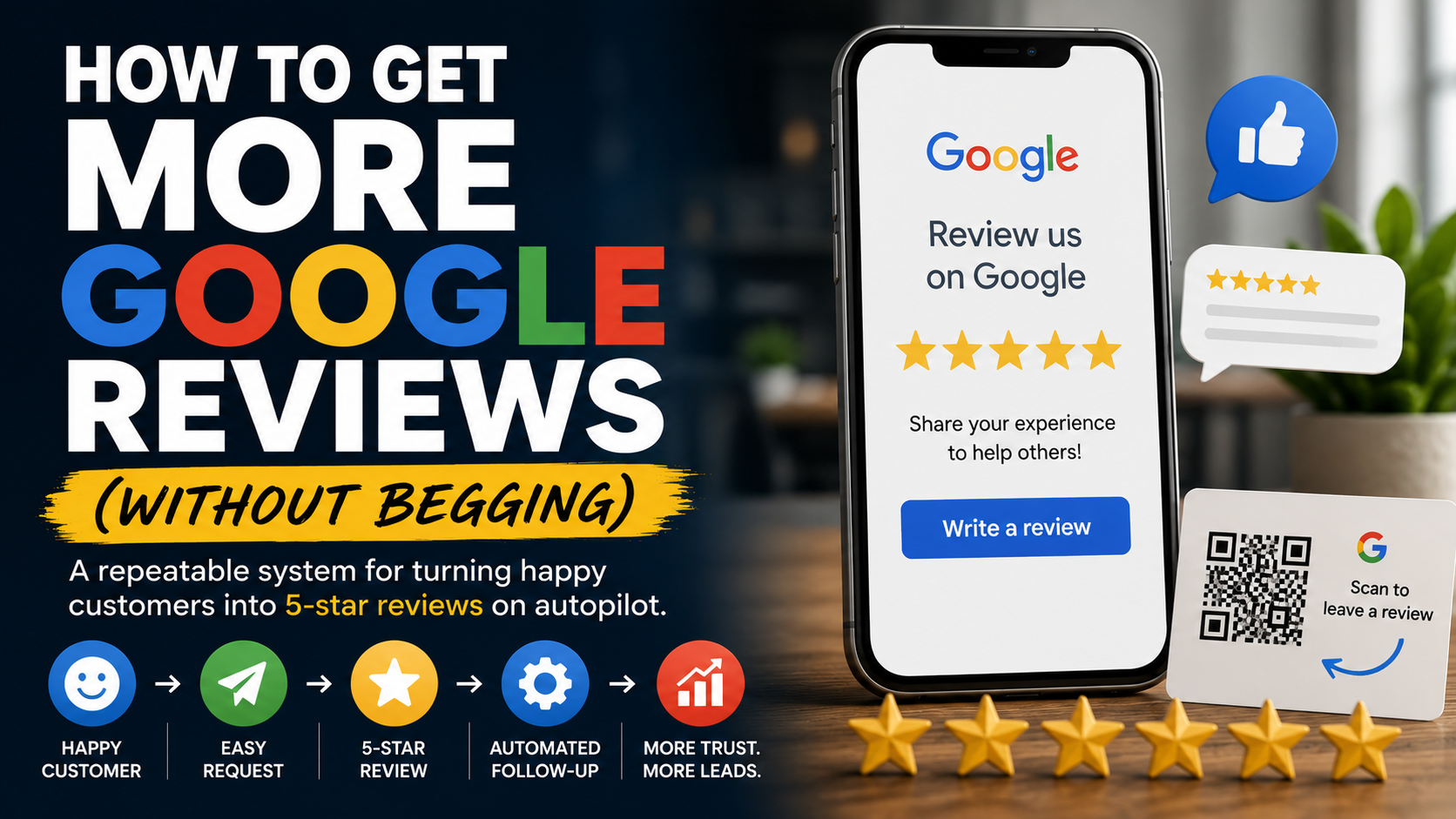
How to Get More Google Reviews (Without Begging)
A repeatable system for turning happy customers into 5-star reviews on autopilot.
Google reviews have become one of the most valuable marketing assets a local business can have. They influence how customers perceive your company, play a role in your visibility in local search results, and often determine whether someone chooses your business or a competitor's.
Think about your own buying habits. When you're looking for a restaurant, contractor, dentist, or marketing agency, what's one of the first things you check?
For most people, it's the reviews.
A business with hundreds of recent, positive reviews immediately feels more trustworthy than one with only a handful. Even if both businesses provide exceptional service, the one with more reviews usually earns more clicks, more phone calls, and more customers.
The challenge is that most businesses don't have a customer satisfaction problem—they have a review generation problem.
They rely on remembering to ask.
They wait until the end of a project.
They casually mention, "If you have time, we'd really appreciate a review."
Sometimes it works.
Most of the time it doesn't.
The businesses that consistently collect hundreds of five-star reviews aren't begging customers or offering incentives. They've simply built a repeatable system that makes leaving a review the natural next step after a great experience.
Here's how you can do the same.
Why Google Reviews Matter More Than Ever
Google reviews affect far more than your online reputation.
They help potential customers decide whether they trust your business before they ever visit your website or pick up the phone.
When someone searches for a local service, Google often displays your star rating directly in the search results and in the Google Map Pack. Those stars become one of the first impressions your business makes.
Reviews also contribute to your local SEO strategy.
While reviews alone won't guarantee a top-three ranking in Google's Map Pack, businesses with consistent, authentic reviews generally send stronger trust signals than businesses with very few reviews.
Google wants to recommend businesses that provide positive customer experiences.
Reviews help prove that you do.
The more quality reviews you earn over time, the more confidence both Google and potential customers have in your business.
Why Most Businesses Struggle to Get Reviews
If you ask most business owners why they don't have more reviews, they'll usually say something like:
"Our customers just don't leave them."
In reality, that's rarely the problem.
Most happy customers are willing to leave a review.
They simply forget.
People get busy.
They finish working with you, move on to the next thing in their day, and never think about it again.
This is why relying on memory almost always fails.
Even customers who absolutely loved your service won't always remember to leave a review unless you make the process incredibly simple.
Instead of hoping customers eventually remember, successful businesses build review requests into their normal workflow.
Reviews shouldn't be something you occasionally remember to ask for.
They should happen automatically after every successful customer interaction.
Great Reviews Start With Great Customer Experiences
No review strategy can make up for poor customer service.
Before focusing on automation or software, ask yourself an important question:
Would your customers naturally recommend your business to a friend?
If the answer isn't a confident yes, improving your customer experience should become the first priority.
Customers leave enthusiastic reviews because something exceeded their expectations.
Maybe your communication was excellent.
Maybe you finished the project ahead of schedule.
Maybe you solved a problem another company couldn't.
Every memorable customer experience increases the likelihood of receiving a review.
The review request simply gives customers an opportunity to share what they're already thinking.
Timing Is Everything
One of the biggest mistakes businesses make is asking too late.
The best time to request a review is immediately after delivering value.
That could be the moment you complete a project, finish an installation, solve a customer's problem, or receive final payment.
At that moment, the experience is fresh.
The customer is excited.
They're far more likely to share positive feedback.
Waiting several weeks dramatically reduces your chances.
The excitement fades.
Life gets busy.
Your request gets buried beneath dozens of emails and text messages.
A review request should become one of the final steps in every completed job.
Not occasionally.
Every time.
Make Leaving a Review Effortless
The more work customers have to do, the fewer reviews you'll receive.
Don't tell customers to "Google us."
Don't ask them to search for your business.
Don't expect them to know where to click.
Instead, send them directly to your Google review page.
Whether you send that link through text message, email, a QR code, or your customer management system, removing unnecessary steps dramatically improves completion rates.
People appreciate convenience.
The easier the process becomes, the more reviews you'll collect.
Personal Requests Always Work Better
Customers can immediately recognize generic marketing messages.
A simple, personal request almost always performs better than a long email explaining why reviews are important.
Thank them for choosing your business.
Mention the service you provided.
Tell them you appreciate their feedback.
Keep it conversational.
Customers don't want to feel like they're helping your marketing department.
They want to feel like they're helping someone who genuinely values their opinion.
Authenticity consistently outperforms sales language.
Build an Automated Review System
Automation often sounds impersonal, but it doesn't have to be.
In fact, automation simply guarantees consistency.
Imagine this workflow.
A customer pays their invoice.
Within a few hours they automatically receive a thank-you message with a direct link to leave a Google review.
If they leave a review, the workflow ends.
If they don't, a friendly reminder is sent several days later.
If there's still no response, one final reminder goes out a week later before the system stops.
Everything happens automatically.
No one on your team has to remember.
No customers fall through the cracks.
Every satisfied customer receives the same opportunity to share their experience.
That's how businesses consistently collect reviews month after month.
Respond to Every Review
Getting reviews is only half the process.
Responding to them is equally important.
Many businesses respond with the exact same sentence every time.
"Thanks for your review."
While that's better than saying nothing, it doesn't add much value.
Instead, personalize your responses.
Mention the customer's project.
Thank them for trusting your business.
Acknowledge something specific they mentioned.
Future customers read your responses too.
Professional, thoughtful replies demonstrate that your business values customer relationships.
Negative reviews deserve attention as well.
Stay calm.
Remain professional.
Never argue publicly.
Offer to resolve the issue offline whenever possible.
Potential customers don't expect perfection.
They expect professionalism.
How you respond often matters more than the review itself.
Never Buy Reviews
Some businesses try to shortcut the process by purchasing fake reviews or paying customers to leave positive ratings.
It's a terrible long-term strategy.
Google actively discourages review manipulation and has become increasingly effective at identifying suspicious review activity.
Fake reviews damage trust.
Authentic reviews build it.
The goal isn't to have the most reviews.
The goal is to have the most trustworthy reviews.
A hundred genuine reviews from satisfied customers will always outperform hundreds of questionable reviews that customers can immediately recognize as fake.
Consistency Beats Large Review Campaigns
Many businesses run one review campaign each year.
They ask everyone they've ever worked with to leave a review.
They collect fifty reviews in a month.
Then they stop asking.
Google prefers consistency.
Receiving a handful of new reviews every month looks much healthier than receiving dozens all at once followed by months of silence.
Recent reviews demonstrate that your business continues providing excellent service.
They also reassure potential customers that your business remains active.
Your goal shouldn't be to collect as many reviews as possible this month.
Your goal should be to create a process that continues producing reviews every month for years.
Reviews Help More Than Local SEO
The benefits of Google reviews extend far beyond rankings.
Businesses with stronger review profiles often experience higher click-through rates because customers naturally trust businesses with better reputations.
More clicks usually lead to more website visitors.
More visitors create more opportunities for conversions.
Reviews also help customers answer questions before contacting you.
Many people specifically look for comments about communication, pricing, professionalism, turnaround times, and customer service.
A healthy collection of detailed reviews often eliminates objections before a conversation even begins.
Reviews also provide valuable feedback.
Patterns begin to emerge.
You'll discover what customers appreciate most about your business and identify opportunities for improvement.
Listening to that feedback helps create even happier customers, leading to even more positive reviews over time.
Build Reviews Into Your Company Culture
The businesses with hundreds or thousands of reviews don't think about reviews as a marketing tactic.
They think about them as part of their customer experience.
Every employee understands the importance of customer feedback.
Every completed project follows the same process.
Every satisfied customer receives an opportunity to leave a review.
The result is predictable growth.
Instead of wondering whether someone might remember to leave a review, the business knows every customer has been given an easy opportunity to share their experience.
That's the difference between businesses with twenty reviews and businesses with five hundred.
One hopes.
The other has a system.
Final Thoughts
Google reviews are one of the few marketing assets that continue delivering value long after they're earned. Every authentic review builds trust, strengthens your online reputation, supports your local SEO, and helps future customers feel confident choosing your business.
The secret isn't asking louder or begging customers for five stars.
It's creating an exceptional customer experience and making it incredibly easy for happy customers to share it.
When review requests become part of your normal business process instead of something you occasionally remember to do, your online reputation begins growing almost automatically.
At We Are Aerial, we help businesses build marketing systems that create sustainable growth. From Local SEO and Google Business Profile optimization to website design, automation, and lead generation, we focus on creating repeatable processes that generate more visibility, more trust, and more customers.
If your competitors are collecting reviews faster than you are, chances are they don't have happier customers—they simply have a better system. Once you build one of your own, those five-star reviews will start working for your business every single day.