
Why Your Business Isn't Showing Up in the Map Pack
The 5 things Google checks before deciding who ranks in the top 3 local results — and how to fix each one.
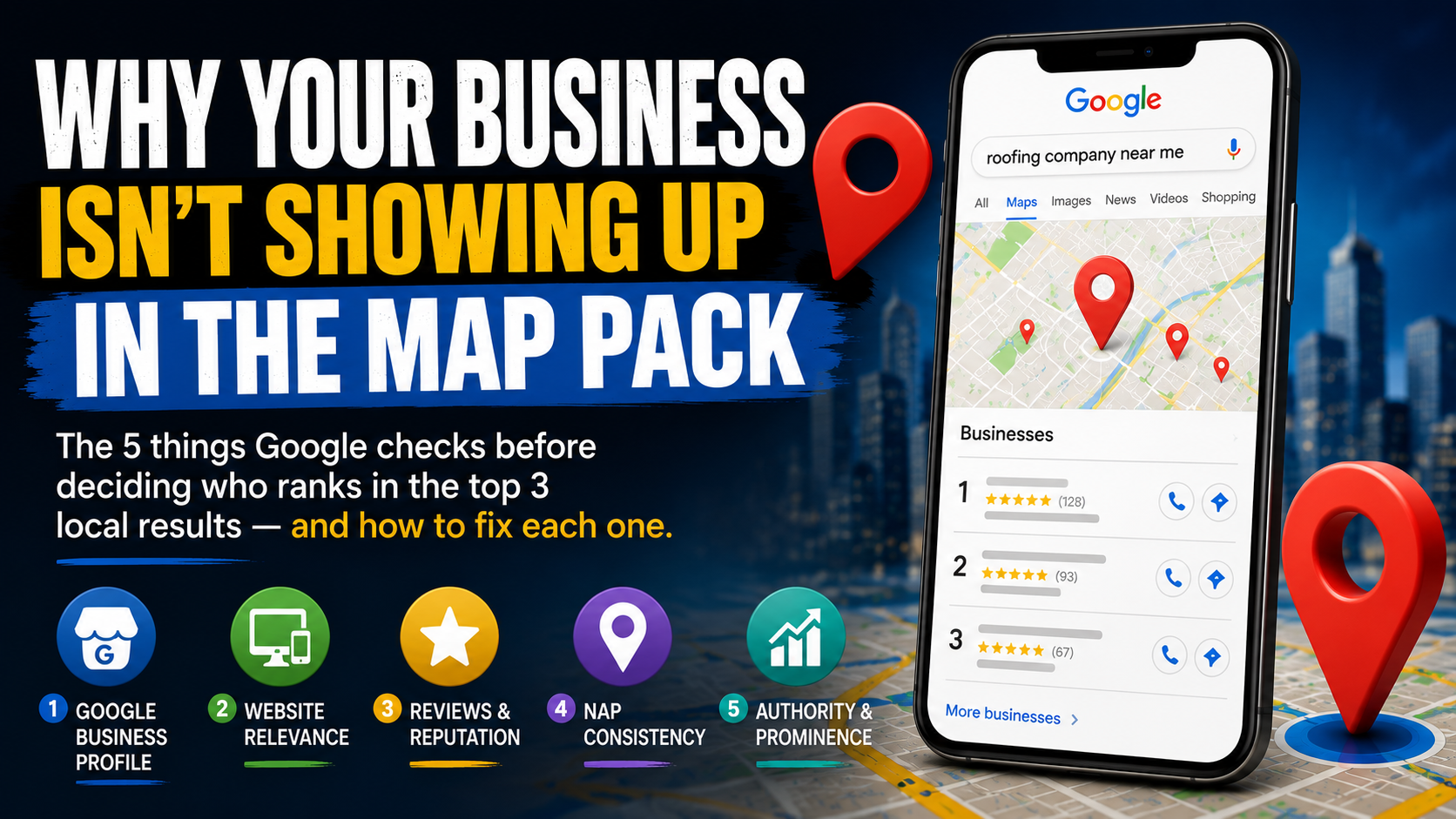
If you've ever searched for a service like "roofing company near me," "marketing agency near me," or "plumber in Nashville," you've probably noticed that Google displays a map followed by three business listings before the regular search results. Those three listings are known as the Google Map Pack (also called the Local Pack or 3-Pack), and they represent some of the most valuable real estate on the internet for local businesses.
For many companies, appearing in the Map Pack generates more phone calls, website visits, direction requests, and qualified leads than ranking first in the traditional organic search results. That's because the Map Pack is designed for people who are ready to take action. They're not casually browsing—they're looking for a business they can contact right now.
If your competitors consistently appear there while your business doesn't, it can feel frustrating. You may have a great website, provide excellent service, and have loyal customers, yet your business remains invisible when potential customers search for the services you offer.
The good news is that Google doesn't choose businesses at random. It evaluates hundreds of ranking signals to determine which companies deserve those top three positions. While Google's algorithm is constantly evolving, the same five core factors continue to play the biggest role in local rankings.
Understanding these factors—and knowing how to improve them—can make the difference between being overlooked and becoming one of the businesses customers see first.
How Google Decides Who Appears in the Map Pack
Google's mission is simple: provide users with the most relevant, trustworthy, and helpful businesses for every search.
When it comes to local search results, Google has publicly stated that rankings are primarily based on three concepts:
Relevance is how closely your business matches what someone is searching for.
Distance is how close your business is to the searcher or the location included in the search.
Prominence is how well-established and trusted your business appears online.
These broad concepts are supported by hundreds of smaller ranking signals that help Google determine whether your business deserves a top position.
Many business owners assume there's a secret trick that instantly boosts rankings. Unfortunately, there isn't.
The businesses that consistently rank well simply do many small things correctly—and they do them consistently over time.
Let's look at the five biggest factors Google evaluates before deciding who appears in the Map Pack.
1. Your Google Business Profile Isn't Fully Optimized
Your Google Business Profile is the foundation of your local SEO strategy.
Before Google recommends your business, it needs to understand exactly who you are, what you do, and where you operate.
Unfortunately, many businesses claim their profile, enter the basics, and never update it again. Months—or even years—pass without adding new photos, updating services, responding to reviews, or checking whether the information is still accurate.
Google notices active businesses.
Profiles that are regularly updated send stronger trust signals than profiles that appear abandoned.
One of the most important decisions you'll make is selecting the correct primary business category. Your primary category tells Google what your business actually is, while secondary categories help explain additional services you provide.
Your business description should clearly explain who you help, what services you provide, and what makes your company different.
Your services should be fully completed rather than using generic descriptions.
Your business hours should always be accurate, especially during holidays.
Adding high-quality photos also makes a significant difference. Customers want to see your team, office, completed projects, products, and the experience they can expect when working with you. Businesses that regularly upload photos often receive more engagement than businesses with only a logo.
Google Posts are another overlooked opportunity. While they won't instantly improve rankings, regularly publishing updates, promotions, events, or educational content demonstrates that your business is active and engaged.
Think of your Google Business Profile as your digital storefront.
The more complete, accurate, and active it is, the more confidence Google has in recommending your business.
2. Your Website Doesn't Support Your Local Rankings
Many business owners believe their Google Business Profile does all the work.
It doesn't.
Your website acts as the evidence behind everything your Business Profile claims.
Google continuously compares your website with your Business Profile to verify that both tell the same story.
If your profile says you offer Local SEO services, your website should have a detailed page explaining your Local SEO process.
If your profile says you build websites, your website should demonstrate that expertise through dedicated service pages, examples, and helpful educational content.
One of the biggest mistakes businesses make is trying to rank every service on a single page.
Imagine visiting a marketing agency's website and finding one page that briefly mentions SEO, Google Ads, website design, branding, social media management, email marketing, logo design, and video production.
While that page may list everything the company offers, it doesn't explain any one service deeply enough for Google to recognize expertise.
Instead, every major service should have its own dedicated page.
Each page should thoroughly answer the questions customers commonly ask before making a purchasing decision.
Google rewards websites that solve problems—not websites that simply include keywords.
Publishing educational blogs is one of the best ways to build topical authority.
Every helpful article gives Google another opportunity to understand your expertise while helping potential customers make informed decisions.
Technical SEO also matters.
Your website should load quickly, be mobile-friendly, use HTTPS, have a logical navigation structure, and provide a positive user experience.
When your website reinforces everything your Google Business Profile says, Google gains greater confidence that your business deserves higher visibility.
3. Your Reviews Show Google Whether Customers Trust You
Reviews influence both rankings and customer decisions.
Every positive review helps build trust with potential customers while providing Google with evidence that people have had positive experiences with your business.
However, it's not just the number of reviews that matters.
Google also considers review quality, review frequency, review freshness, and how customers describe their experiences.
A business with hundreds of reviews collected several years ago may appear less active than a business consistently earning new reviews every month.
Recent reviews demonstrate that your business continues providing quality service.
Google also analyzes the language customers naturally use in reviews.
When customers mention specific services, locations, or positive experiences, those reviews provide additional context about your business.
Responding to reviews is equally important.
A thoughtful response demonstrates professionalism and customer engagement while reinforcing trust with future customers.
Even negative reviews present an opportunity.
No business is perfect.
Customers understand that.
What matters is how your business responds when something goes wrong.
Professional, respectful responses often leave a stronger impression than pretending negative feedback doesn't exist.
Building reviews should become part of your normal business process rather than something you only think about occasionally.
The businesses dominating local search don't ask for reviews once in a while.
They've built systems that consistently generate new reviews every month.
4. Your Business Information Isn't Consistent Across the Internet
Google wants confidence that your business information is accurate.
If your website lists one phone number, Facebook lists another, Yelp still has your old address, and several directories use different versions of your business name, Google begins to lose confidence.
This consistency is commonly known as NAP consistency, which stands for:
Name
Address
Phone Number
Every major business directory should display the same information.
Even small differences can create confusion.
For example:
We Are Aerial
versus
We Are Aerial LLC
Or:
Suite 200
versus
#200
Individually, these differences seem minor.
Collectively, they create uncertainty.
Google also looks at business citations across trusted websites.
Directories like Google Business Profile, Apple Maps, Bing Places, Yelp, Better Business Bureau, Facebook, and industry-specific directories all help verify your business information.
Quality matters far more than quantity.
A handful of accurate listings on trusted websites is far more valuable than hundreds of low-quality directory submissions.
If you've changed addresses, phone numbers, or business names, updating every major citation should be a priority.
5. Your Competitors Have Built More Authority
Sometimes your website is solid.
Your Google Business Profile is optimized.
Your reviews are growing.
Your citations are accurate.
Yet your competitors still outrank you.
The reason is often authority.
Google compares businesses against one another.
Authority develops over time through consistent effort.
Businesses that rank well often have stronger backlinks, more educational content, higher-quality websites, greater customer engagement, stronger brand recognition, and more mentions across the web.
Authority isn't built overnight.
It's earned.
Publishing valuable blog content, improving your website, earning quality backlinks, collecting reviews, and consistently optimizing your online presence all contribute to stronger authority over time.
There are no shortcuts.
The businesses dominating Google's Map Pack usually earned those positions through months—or years—of consistent improvement.
Common Mistakes That Keep Businesses Out of the Map Pack
Many businesses unknowingly hurt their local rankings by making avoidable mistakes.
Keyword stuffing your business name, purchasing fake reviews, creating thin service pages, ignoring negative reviews, allowing outdated business information to remain online, neglecting mobile optimization, and abandoning your Google Business Profile after setting it up can all weaken your local SEO.
Google has become increasingly effective at identifying businesses attempting to manipulate rankings.
Instead of looking for shortcuts, focus on creating a better experience for your customers.
That's exactly what Google wants to reward.
How Long Does It Take to Rank in the Map Pack?
This is one of the most common questions business owners ask.
The honest answer is that it depends on your starting point, your competition, and how consistently you improve your local SEO.
Businesses with a strong foundation may notice improvements within a few weeks after fixing existing issues.
More competitive industries often require several months of consistent optimization before meaningful ranking improvements occur.
Google needs time to crawl your website, process updates, evaluate new reviews, recognize improved authority, and compare your business with competing businesses.
Local SEO isn't a one-time project.
It's an ongoing investment.
The businesses that continue improving are usually the businesses that continue climbing.
Final Thoughts
Showing up in Google's Map Pack isn't about luck.
It's about building trust.
Google wants to recommend businesses that provide accurate information, demonstrate expertise, maintain strong online reputations, and consistently deliver positive customer experiences.
If your business isn't appearing in the top three local results today, don't assume you're doing everything wrong.
More often than not, there are several opportunities to strengthen the signals Google uses to evaluate local businesses.
Start by optimizing your Google Business Profile, improving your website, earning consistent customer reviews, correcting outdated business information across the web, and continuing to build your authority through helpful content and ongoing SEO.
Every improvement increases Google's confidence in your business.
And when Google has confidence in your business, your customers are much more likely to find you.
If you're not sure what's preventing your business from ranking higher, We Are Aerial can help. Our local SEO experts perform comprehensive audits that identify the issues holding your rankings back and develop a strategy designed to increase your visibility, generate more qualified traffic, and help your business earn more leads from local search.